Wednesday, August 11, 2010

R.I.P. Antonio Pettigrew

Early yesterday morning I got a text message telling me that Antonio Pettigrew had been found dead. As the day progressed details began to fill in. He was in his car. Involved an overdose of sleeping pills.

As I read the various articles that came out over the course of the day, I almost came to believe that Pettigrew had a short athletic career that began and ended with the Sydney Olympics in 2000. Because almost everything that was written detailed his admission of doping between that season, and how he and his teammates were stripped of their relay medals from the Sydney Olympics as a result.

But I remember Pettigrew long before 2000, because he was a mainstay of US international squads long before that. As a matter of fact he ran 44.27 as far back as 1989 when he was the world leader on the clock over all time greats Butch Reynolds (44.30), Danny Everett (44.36), and Steve Lewis (44.47) among others.

He would win a National title in 1991 in 44.36 and go on to win the World Championships gold medal in Tokyo in 44.57 defeating British great Roger Black (44.62), Danny Everett (44.63) and Cuban great Roberto Hernandez (44.86). The following season would see Michael Johnson begin his string of title runs in the event, so there was no more individual gold for Pettigrew, but he was a member of gold medal relay squads in Athens ‘97 (43.1 split), Seville ‘99 (43.8 split), as well as the oft mentioned team of Sydney.

He was consistently among the world’s top 400 men throughout his career with season’s bests of 44.71 (‘92), 44.45 (‘93), 44.43 (‘94), 44.23 (‘97), 44.40 (‘98), and 44.21 (‘99) before the 2000 season (44.57). So unfortunately while many will remember the negative note that his career ended on, there was much success long before the end. My recollection of the positive aspects of his career is not to dismiss the negative, but to remind that he was as any man with both positive and negative in his life – and in this case his career.

My heart goes out to those he left behind – his wife Cassandra, and son Antonio Jr. May he rest in peace.

Monday, August 9, 2010

My Two Cents on the After Spin of the Stockholm 100

ATTENTION EDITORS - REUTERS PICTURE HIGHLIGHT TRANSMITTED BY 1925 GMT ON AUGUST 6, 2010.   SIN504 Tyson Gay of the US wins the men's 100 metres final ahead of Jamaica's Usain Bolt at the IAAF Diamond League DN Galan in Stockholm  REUTERS NEWS PICTURES HAS NOW MADE IT EASIER TO FIND BEST PHOTOS FROM MOST IMPORTANT STORIES AND TOP STANDALONES EACH  Search for TPX in the IPTC Supplemental Category field or  IMAGES OF THE DAY  in the Caption field and you will find a selection of 80-100 of our daily Top Pictures.  REUTERS NEWS PICTURES, SINGAPORE TEMPLATE OUT

In the days since Tyson' Gay’s “upset” victory over Usain Bolt, much has been written and said. From message board arguments, to newspaper articles, to other bloggers. Everyone has been trying to “figure out” and/or “explain” how the “unbeatable” Usain Bolt lost to Tyson Gay. I’ve seen everything from “Bolt didn’t take Gay seriously”; to “Bolt wasn’t trying”’ to Bolt was out of shape”; to “the race didn’t matter”.

I’m going to chalk up most of the post race chatter to either youth – haven’t been watching the sport very long). Nationalism – we all like to think “our” athletes are unbeatable). Fanaticism -  fans sometimes get so wrapped up in their athletes they refuse to believe anything negative can happen. Media Hype – the media loves to build up individuals and teams to seem unbeatable. Because the reality of Stockholm, and all the races that have and will take place this year, is that they are not some Electronic Arts video game with artificial characters taking part, but real flesh and blood individuals competing against each other – and all real people are beatable.

Let’s start with world record holders. World record holders get beat sometimes. Since the first auto timed world record in the 100 was set in Mexico City in 1968 every world record holder has been beaten. Jim Hines, Calvin Smith, Ben Johnson (later taken away), Carl Lewis, Leroy Burrell, Donovan Bailey, Maurice Greene, Tim Montgomery, Asafa Powell, and now Usain Bolt. Every last one was beaten while holding the WR. All except Ben Johnson who tested positive just after, and he was beaten in Zurich just before his record setting run. And, interestingly enough, neither Smith, Lewis, Burrell, Bailey, Montgomery, or Powell won a major championship while holding the WR. So for those with short memories, being the world record holder is no guarantee of victory.

Neither is being seemingly “invincible”. Edwin Moses met his “Waterloo” in Madrid after dominating the 400 hurdles without a loss in 122 straight races – then lost gold in Rome. Carl Lewis was the most dominant long jumper we’ve ever seen winning in Helsinki, Los Angeles, Rome, and Seoul before setting his lifetime best in the event in Tokyo – while losing! Michael Johnson ran a stunning 19.32 in Atlanta, then ran a match race against Donovan Bailey over 150 and lost. There are many, many others, but the point is simple – great athletes lose. Primarily because the competitions aren’t video games. And in real life you have to factor in the heart, desire, and competitive nature of the competition. Andre Phillips got tired of losing to Edwin Moses – so he worked to try and change that paradigm. Same for Mike Powell when it came to Carl Lewis – he wanted BADLY to turn the tables. And Donovan Bailey was out to prove that it was the 100 WR holder and not the 200 WR holder that was indeed the world’s fastest man!

Former Houston Rockets coach Rudy Tomjonovich once said “never underestimate the heart of a champion” and Winston Churchill once said “never, never, never give up”. Such is the nature of human beings that some refuse to be down for long. To date the greatest 100 meter runner in history, Maurice Greene (Bolt has a few more titles to win) rose up from the depths of being defeated. By contrast, multiple record setters Leroy Burrell and Asafa Powell, were unable to find victory when it mattered most. One of my favorite sayings (at least I think I said it first) is “it ain’t how fast you run, it’s when you run fast”. Meaning that regardless of how fast an individual is he/she has to be able to do so when it matters most. It is those intangibles – desire and ability to perform at one’s best under pressure – that make most champions.

Bolt is indeed a champion. He has performed at the highest level in back to back championships winning four individual gold medals and four world records in the process. But everyone seemed to forget that Tyson Gay has crossed the line first twice in a major championship himself. One of those races beating a man – Asafa Powell – that was the WR holder and supposed to be able to destroy him. That was considered an “upset” by many as well. But Gay, when faced with tough odds, always seems able to bring his best.

The other gold medal that Tyson Gay won in Osaka was against Usain Bolt himself in the 200 – the last time the two have met over the distance. Now, since then much has been chronicled about how much Usain Bolt has improved in the interim – all the way to 9.58 & 19.19. But what has gone unnoticed apparently is how much Tyson Gay has improved as well. The man that beat Usain Bolt was no 9.9x 100 meter man taking a shot at the big man. He wasn’t even the 9.84 sprinter that took down Asafa Powell in Osaka. Tyson Gay is the second fastest sprinter in history at 9.69! And over the last two seasons has run – 9.68w, 9.69, 9.71, 9.75w, 9.76w, 9.77, 9.77, 9.79w, 9.79w – 9 races legal and windy under 9.80. Guess how many races under 9.80 Usain Bolt has run, windy and legal,  in the same time frame – 7. So Tyson Gay has proved to have as much “leg speed” (i.e. able to run as fast) as Bolt. So Gay being able to defeat Bolt should NOT be that big a surprise. Besides, after Stockholm their record is only 2-1 in favor of Bolt (not sure where TFN is coming up with a third win). So it’s not as if Bolt has this long history of defeating Gay.

Of course the trump card here for Usain is that he has performed his best two times under the spotlight of the Olympics and World Championships. Which reminds me of a Maurice Greene quote. When asked how he felt his WR 9.79 compared to the 9.84 record of Donovan Bailey that he took down, Mo said in effect “his came on the big stage”! Because world records set in the Games and Worlds take on a superhuman persona. Those races seem bigger than life. and those that run them become bigger than life. And setting records in both – double records at that – has given Bolt the persona of being bigger than life.  But at the end of the day – or perhaps I should say prior to taking to the blocks – he still has to pull his designer uniform over his head just like the other competitors, and lace up his yam colored shoes just as they do.

And for some of his competition, those designer duds have a target on the back. Again quoting Mo Greene, when asked how he trained being “The Man” he in effect said “I train like #2, trying to be”. Because the true competitors of the sport are always trying to get to #!. And when you’re Mo Greene, Carl Lewis or Edwin Moses, YOU are the goal of those with true heart! Which is why there is no “unbeatable”, just those that haven’t been defeated YET. How long that takes depends on both the “hunters” and the “hunted” – what you do to stay there and what you do to get there.

So for all those looking for “reasons” why Bolt lost perhaps you’re looking at the wrong person and the wrong reasons. It may not be all about Bolt and whether or not he wanted or didn’t want to win – sounds rather ridiculous to even say. Yes he was injured earlier, but has since run 9.86 and 9.82 and defeated Asafa Powell who has also run 9.82 this season. And Tyson Gay has had injury ills of his own this season (and last). But then, to get a race full of athletes that are all 100% on any given day is somewhat of a fallacy. Charlie Greene took to the starting line of the 100 in Mexico City with a hamstring issue. Ditto Tommie Smith in the 200. Jim Hines beat Charlie Greene, Tommie Smith won gold in a WR. Calvin Smith was injured at the Trials in ‘84, Carl Lewis went on to double gold. Mo Greene pulled up during the race in Edmonton yet held off Tim Montgomery for the win. Tyson Gay took to the starting line in Berlin having nursed a groin all season – lost to Bolt, defeated Powell. When you line up only track nerds like me remember what your condition was, history simply writes down the results – wins, losses and times.

And to question that an athlete would step to the track with the intent to do anything less than their best, or would not try once there, impugns the integrity of the athlete – and ultimately of the sport. Champions – those with the hardware and those working hard to get it – are competitive by nature. You show up to win – in some cases against all odds. To do, or to assume that one would do, anything less begins to make assumptions about integrity that shouldn’t be uttered.

They ran a race and someone won and seven others lost. That’s how it works. Some win more than others, but all can lose. Shock and surprised? No I’m not. But then my memory is a lot longer than some others. Frankly it’s good for the sport. I’ve said all year that the sport needs rivalries and that we need to tout more than one or two athletes. Bolt v Gay can be exciting for the sport – especially when there is a question as to what the outcome might be. Predictability leads to boredom – and that’s the last thing this sport needs. We need excitement. Look at how much discussion this one race has elicited! Imagine what four or five races/events like this a week could do for track and field.

Saturday, August 7, 2010

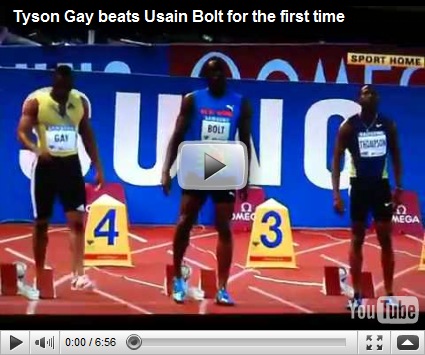
Tyson Gay Defeats Usain Bolt in Stockholm

STOCKHOLM, SWEDEN - AUGUST 06: Tyson Gay (2nd r) of USA wins the men's 100m from Usain Bolt (r) of Jamaica during the IAAF Diamond League meeting at the Olympic Stadium on August 6, 2010 in Stockholm, Sweden. (Photo by Michael Steele/Getty Images)

Now we officially have a sprint rivalry with Tyson Gay’s defeat of Usain Bolt (9.84 to 9.97) in the Swedish city of Stockholm. It was Bolt’s first defeat over the distance since July 22, 2008 when he lost to countryman Asafa Powell on this same track. It was also Gay’s first win over Bolt, although they had only met over this distance on two other occasions. A stat that has gone somewhat under the radar as Bolt has run roughshod over the rest of the world over the past two seasons.

With Usain Bolt setting three WRs in the event over the past two seasons (9.72, 9.69 & 9.58) and winning both the Olympic and World titles over the distance, many had come to think of Bolt as unbeatable. And quite frankly, his showings under the bright lights on the big stages of Beijing and Berlin gave a pretty good indication that he just might be Superman, as he obliterated both his competitors and the world record on each occasion. Unfortunately, as I have lamented on several occasions, head to heads against the world’s top dash men – currently Bolt, Gay, and Asafa Powell – are nearly as rare as blue diamonds. So with Bolt and Gay meeting only once in ‘08 and once in ‘09 over their careers, Bolt’s dominance has been defined by his Championship wins – the second in Berlin over Gay – not by a series of wins over his main rivals.

But Gay has quietly been demonstrating that he does have the goods to get it done – with a series of sub 9.80 runs of his own over the past two seasons that included a sizzling 9.69 AR that came courtesy of a poor start. And it is there that Bolt has excelled in his two previous victories over Gay, and where Gay turned the tables in Stockholm – at the start. On many occasions when previewing sprint match ups that feature strong finishers I have stated that it is the first 30 meters that typically decides the race. And Bolt and Gay are two of the strongest finishers the planet has ever seen.

In their first meeting in New York in 2008, Gay nailed the start of the race – but the race was called back due to a false start. On the second go it was Bolt that nailed the start and held off Gay with a new WR 9.72 (Gay 9.85). Gay showed that he too could run in that range at the Olympic Trials the following month with 9.77, 9.68w clockings of his own. But fell to injury in the 200 and was unable to make the 100 final in Beijing – won by Bolt in a WR 9.69. Both went into Berlin with fast season’s bests – Bolt 9.79, Gay 9.77. And though there was talk of Gay’s groin injury, the real story was told in the first 30 meters of the race as Bolt was the fastest man in the race to 30 and never looked back as he passed the line in his WR 9.58 (Gay runner up in 9.71).

So Gay had performed well against Bolt in both previous meetings, but you can’t give up ANY ground to Bolt early and hope to run him down. Just as, prior to Stockholm, all but Bolt knew that they could not give up any ground to Gay early and hope to run HIM down. Stockholm solidified the race model that neither Bolt nor Gay can be allowed to get in front early, as both have far too much top end speed to be run down – even by each other.

To their credit both men were gracious following the race. Bolt stating that it just wasn’t his day. Gay saying he wanted to defeat Bolt when he was at his best – as Bolt has had some injury issues this season. Of course Gay has had some injury issues of his own, and I applaud BOTH athletes for stepping to the track and running the race. Because that has been missing in the sprints – warriors going head to head in spite of not being 100%.

Bolt may take the next one, or even the next couple. Then again Tyson may turn the trick yet again. The one thing I can say with confidence is that the winner will be determined in the first 30 meters. With the man that passes that mark first fairly sure to win it. I’m looking forward to as many of their races as we can get.

By the way, there were other goings on in Stockholm. It just seems that the “Showdown” was the only event in town. And looking quite dominant was Bershawn Jackson as he demolished the 400H field. Jackson has gone back to a 15 step pattern and has shown that this event is all about rhythm as he has gotten himself into a zone! Today’s win in 47.65 put him well ahead of second place (48.50). It was Jackson’s 4th run under 48.00 this season – the entire world only had 3 in 2009. Jackson is beginning to churn out quality races like Edwin Moses and Kevin Young – the previous and current WR holders. At his current rate “Batman” is going to be hard to beat come Daegu.

While not turning in dominant performances, Chris Solinsky is beginning to look like a serious competitor over 5/10K. The world leader this year in the 10000 meters, Solinsky ran his favorite race in Stockholm – the 5000. And for the second consecutive run he set a personal best as he ran with the leaders throughout and finished fifth in 12:55.53 – the #2 in US history and faster than the American Record at the start of the year. Solinsky ran the kind of race I’ve hoped to see American’s run – stay with the pack and not let go. Chris did this and it wasn’t until the kickers did their thing that Solinsky truly lost contact, and finished only 2 seconds off the winner. He’s made great strides this year and is looking like a potential finalist in Daegu. Who knows what could happen then?

Christian Cantwell continued to show that he is currently the king of the shot, as he was the only thrower over 70 feet shoving the ball 72’ 5.75”, well clear of the 68’ 11.25” for second place Tomas Majewski (POL). While Chaunte Howard Lowe continued to show that she and Blanka Vlasic are in a different class than the rest as they once again dueled in the high jump. Vlasic (6’ 7.5”) winning another tough battle over Howard Lowe (6’ 6.75”). The US was also treated to solid performances by Brittney Reese (2nd, long jump), Debbie Dunn (2nd, 400), Allyson Felix (1st, 200), and Lolo Jones (3rd, 100 hurdles). And even though she was only 5th, Morgan Uceny continues to be impressive in the middle distances – this time over 1500. She continues to be a fierce competitor, running close to the leaders in every race she’s in. Her 4:02.72 was just off her best of 4:02.40 set a month earlier in Lausanne and her competitiveness seems to keep her in every race she’s in. I expect her to be a factor in 2011.

All in all a very good meet with solid performances by American forces and of course the victory heard round the world. Makes one look forward to the upcoming Aviva meet in London.


Top Five 100’s for Sprinting’s Big Three

Usain Bolt Tyson Gay Asafa Powell
     
9.58 9.68w 9.72
9.69 9.69 9.72w
9.72 9.71 9.74
9.76 9.75w 9.75w
9.77 9.77 9.77

Friday, August 6, 2010

A Look at the Career of Asafa Powell

Jamaican Asafa Powell looks for the race results after the men's 100m final competition at the Paris IAAF Diamond League meeting at the Stade de France near Paris on July 16, 2010.  UPI/David Silpa Photo via Newscom

Late Wednesday came word that Asafa Powell (JAM) was pulling out of the Stockholm Showdown with Usain Bolt (JAM) and Tyson Gay (US). While I was disappointed when I got the text message alerting me to the news I was not entirely surprised. One because the trade mark of elite sprinting in the New Millennium has been the lack of top level match ups in the men’s short sprints (100/200). The other because the history of Asafa Powell is rife with missed/avoided big races.

Powell became a blip on the sprint radar in 2003. That season was his first under 10.10 as he ran to a PR 10.02 in Brussels. It was marked, however, by his quarterfinal at the World Championships in Paris in which he and Jon Drummond both false started out. The Olympic season of 2004 saw dramatic improvement in his times as he improved down to 9.87 (again in Brussels). But his undefeated season was marred by his 5th place finish in the Olympic final. These two “inaugural” seasons among the elite were the last where we saw Powell compete regularly and against all comers (specifically the best of the elite) on a regular basis.

2005 saw Powell get even faster, as he had a spectacular (at that time) series of races in May/June that culminated in a new WR – 9.84 (Kingston), 9.85 (Ostrava), 9.84w (Eugene), 9.77 WR (Athens). This series of races was highlighted by two things. One was a loss to Olympic Champion Justin Gatlin in Eugene which would mark the last time the two would go head to head – and Powell’s last head to head against a top rival outside of a major championship until 2008. And Powell’s first injury in what has become a recurring series of injuries every year since. This one kept him out of the World Championships in Helsinki, as the new WR holder watched as Olympic champion Gatlin added the World title to his resume.

2006 saw both Powell and Gatlin run well early, with Gatlin dominating the clock in May. But it also saw Powell complaining of slight injuries and repeated failures to get both Powell and Gatlin on the track in head to head meetings. Reportedly because Powell felt that as WR holder he should be paid in excess of the Olympic and World Champion. In what has been one of the most ridiculous set of races I’ve ever seen in a meet, we were treated to two separate 100 meter dashes at the 2006 Prefonataine Classic – one featuring Justin Gatlin, the other featuring Asafa Powell – since negotiations couldn’t put them on the track together. Gatlin winning his section in 9.88, Powell his in 9.93w.

The next couple of weeks following Prefontaine saw both seasons change dramatically. Gatlin was suspended for his positive test from the Kansas Relays and didn’t compete again until his race in Estonia earlier this week. Powell regained health, ran throughout Europe, tied his WR 9.77 twice – in Gateshead and Zurich – and in the process ran to a record setting 12 sub10 races during the season. With Gatlin now gone, it appeared that Powell had the sprint wars to himself, but finishing behind Powell in Stuttgart, Berlin, and finally Zurich (in a PR 9.84) was a steadily improving Tyson Gay – and a new challenger for Powell.

2007 saw Gay solidify his growth from ‘06 with a slightly windy 9.76 (+2.2) early on in New York, 9.79 (+2.5) in Carson and a PR equaling 9.84 at nationals. In contrast we got more injury talk from Powell, and no head to heads until the World Championships in Osaka – though we did see Powell in Beograd (9.97), Oslo (9.93), and Rome (9.90). Again the lack of head to heads turned to the talk of contract negotiations in which the WR holder wanted top billing. When they finally met however, Osaka brought Tyson Gay his first global gold medal with a 9.85 victory in which Powell finished 3rd in 9.96. Two weeks later, however, saw Powell run 9.74 & 9.78 in a heat and final on the same day in Rieti – the 9.74 a new WR. A race without Gay or Osaka silver medalist Derrick Atkins as Zurich tried to negotiate a post Worlds race between Powell and Gay, but Powell declined choosing instead to compete in Rieti. Powell ran again in Brussels (9.84) and Stuttgart (9.83) – both without Osaka conquerors Gay and Atkins – before calling it a season.

2008 opened similarly to 2007, with the emergence of another strong rival. But this time the rival was a countryman as Usain Bolt exploded on the scene early with runs of 9.76 (Kingston), 9.92 (Port of Spain) and a WR 9.72 (New York) – with Gay running 9.85 in the New York race. Neither of the three met until Olympic Trials time. At US Trials Gay ran 9.77 (new AR) and 9.68w – then saw his season effectively put to bed with his injury in the 200. At Jamaica’s Trials it was Bolt over Powell (9.85 to 9.97). and the official changing of the hierarchy in Jamaica. Powell’s next race in Rome saw him pull up with a hamstring injury, but return 11 days later to edge Bolt (9.88 to 9.89) in Stockholm. Powell would not face Bolt again until Beijing, but continued with wins in London (9.94) and Monaco (9.82) before placing 5th in Beijing (9.95). Powell once again missed the Zurich race against his Beijing conquerors (Bolt/Thompson/Dix/Martina), but did find his way to Lausanne and a 9.72 PR win minus Bolt.

2009 followed the now established pattern. Top rivals Bolt and Gay opened hot (150 WR with 9.91 en route for Bolt 19.58 for Gay) amid talk of Powell injury. No head to heads until Jamaica Trials with Bolt again over Powell – 9.86 to 9.97. Then a loss to Gay in Rome (9.77 to 9.88) before the bronze medal performance in Berlin – Bolt (9.58), Gay (9.71), Powell (9.84). This was followed by a loss to Bolt in Zurich (9.81 to 9.88) and a loss to Gay in Shanghai (9.69 to 9.85). Then word that he had once again been nursing an injury.

Then of course there has been this season. The outstanding early season for Powell amid talk of being in the best shape of his life, and being ready to set a new PR this season. Then the losses to Gay (Gateshead) and Bolt (Paris). And now word that he has been injured since Paris, with no indication when he may be back on the track. Which more than likely will also negate his appearance in Brussels – up until last week the only confirmed meeting between the world’s three top sprinters this year.

So, as I stated up top, very disappointing, but when one follows the history of Asafa it is not too surprising. While he has become the most prolific sprinter in history with well over 60 sub10 legal clockings to his credit (7 under 9.80!), his spectacular times have come against less than the best in competition. None of his sub 9.80 races have come in a major, and only once (Berlin) has he run under 9.90 in a major. Outside of majors, only a handful of his sub 10’s have come against the superstars of the sprints – his best showing in ‘06 against the then developing Gay.

For most of his career, he has competed against the best of the second tier sprinters. And while this has given him awesome stats – lots of fast times, few loses, and high annual rankings – it hasn’t hardened him to the tough world of the sprint wars. A game where toughness and grit are as much in demand as pure speed – the qualities that win the big races. In contrast his primary competition (Maurice Greene and Justin Gatlin early, and Usain Bolt and Tyson Gay most recently) were all hardened through the rigors of competing against the best early on and taking their lumps!

Greene took hard losses early to the likes of Carl Lewis, Ato Boldon, Donovan Bailey and Bruny Surin before finally coming into his own with his own gold medal in ‘97. Bolt was regularly behind Wallace Spearmon, Xavier Carter, and Tyson Gay before coming into his own. And Gay was a regular behind Justin Gatlin, Leonard Scott, and Asafa Powell himself before coming into his own. They all shared the misfortune (or perhaps fortune) of watching others beat them. Making them more competitive – hungry to turn the tables. They all had to learn to dig down DEEP to find what it takes to win against the best, and to do it under pressure. There was no path of easy, “shut it down” victories on their paths to success. Adversity and challenge was a daily staple. And you could/can see a fierceness in their eyes at the starting line and during the race – competitors that WILL NOT be denied!

And it is this fierceness that Powell has lacked throughout his career. While the best of the best in sprinting have typically been like high end muscle cars – think vintage Chevy Camaro’s, Dodge Charger’s and Shelby Mustang’s – Powell has been more like a Ferrari. Perhaps the fastest car on the road, but you don’t really want to race it against that supercharged Corvette Z1, because like Brian O’Connor in “The Fast and the Furious” you’ll be saying “I almost had you” while the engine is ready to fall on the ground! And that’s where Powell’s career has been to date. Perhaps the fastest car on the road, but a bit delicate for the big races against the supercharged and muscle cars.

It appears that another season is done with no wins against his major competition. And with yet another trio of major championships on tap for 2011, 2012 & 2013, the window on Powell’s career is rapidly closing. In 2005, there were those that took it for granted that he would have triple gold at this point – not the two bronzes and 5th that he picked up. There is no doubt that he is fast. But he and his people are going to have to get him tougher and more resilient if there is any hope that he will make his way to the top of the podium. Bolt and Gay are still young, and there are youngsters like Walter Dix and Yohan Blake that are going through that process of taking their lumps as we speak – and getting tougher and hungry. The road ahead is not getting any easier.

There have been many very fast sprinters that have not gotten been able to master their “muscle car” counterparts when it mattered – Ralph Metcalf, Harry Jerome, Leroy Burrell, Ato Boldon, Calvin Smith, and Frank Fredericks come to mind. Some of the fastest sprinters of their eras – they just couldn’t get past that athlete or two that kept them from ultimate victory. That’s where Powell sits at this moment.

For my money he needs to get tougher. He needs to race more. Needs to take his lumps. Needs to get hungry. He needs to race Bolt and Gay in order to get better. Competing against Mike Rodgers, Keston Bledman, Trell Kimmons and Mario Forsythe isn’t going to get it done. Three and five meter wins against these guys won’t prepare you for the “whoosh” of Usain Bolt or Tyson Gay at the 60 meter mark.

I’m disappointed about Stockholm. Not that I felt that Powell was going to be a game changer in the race, but because we need to see him in the race. I want the event to be more than a head to head among the Big Two. I want to see the final in Daegu as a question mark before the gun for the final goes off. I want to see the 100 meters where it was in the late 90’s – with four or five men taking to the line as EQUALS with the outcome in question. And for THAT to happen we need the best of the best on the track competing against each other on a regular basis. Some need to take their lumps in order to reach the level of the others. Sometimes you have to win in order to lose. And those that fear losing, will. And I think therein lies the career of Powell to date. We will see what story the 2011 Chapter writes.

Thursday, August 5, 2010

Preview – Stockholm Diamond League

Aug 17, 2009; Berlin, GERMANY; Men's 100m winner Usain Bolt (JAM), center, poses with silver medalist Tyson Gay (USA), left, and bronze medalist Asafa Powell (JAM), right, at the 12th IAAF World Championships in Athletics at Olympic Stadium. Photo via Newscom

August has arrived, and with it the final four events of the inaugural Diamond League. The competition has gotten better as the season has progressed and these final four meets promise to be some real barn burners. August should get off with a big BANG as we get our first real sprint showdown with the big three of men’s sprinting – Usain Bolt,  Tyson Gay and Asafa Powell. Many of the European Championships top field event performers will also be in attendance, as well as a strong contingent of distance runners from Africa. So, without further adieu, here are the events I’m most looking forward to in Stockholm.


Men’s 100 WL: 9.82, Asafa Powell – JAM
       9.82, Usain Bolt – JAM
Best Entry: 9.82, Usain Bolt – JAM

This has been an interesting season for the short dash. Typically in an off season we have seen explosions in this event. 2006 saw Asafa Powell with two WR tying runs and the emergence of Tyson Gay. 2002 gave us a WR by Tim Montgomery and a European Record by Dwain Chambers – and BALCO. 1998 saw Ato Boldon twice run within .02 of the WR and Obadele Thompson get within .03. And 1994 gave us a Leroy Burrell WR. This off season has been rather tame in comparison. Powell started off HOT, running several windy 9.7’s. Tyson Gay sizzled a 9.89 en route to his 19.41 straight 200. And Bolt opened up with a 9.86 back in May. But injuries have hampered Bolt and Gay, and Powell has struggled in his head to heads with each. With Bolt and Gay both having defeated Powell in their seasonal returns the questions on the table are: how healthy are they and how will they do against each other? The start will be the key, putting the spotlight on Bolt’s Achilles. IF the Achilles is still tender, Gay (easily the worst starter of the troika) could finally be close enough at mid race. Which I think could lead to a reading of the photo at the finish. If Bolt nails the start then it’s a repeat of Berlin.

Late Note: Word coming out late Wednesday is that Asafa Powell has withdrawn from this race. While I do not think that it will affect the original outcome, it is rather unfortunate. I will comment more later.


Women’s 1500 WL: 3:57.65, Anna Alminova – RUS Best Entry: 3:57.65, Anna Alminova – RUS

This has been a hot event in the Diamond League. Alminova was on a role until she was upset in Barcelona. American Christin Wurth Thomas set a new PR behind Alminova  in Paris, and has been running fearlessly as usual all season. Geleta Burka (ETH) won with her season’s best in Lausanne and wields a deadly kick. And Lisa Dobriskey (GBR) and Nancy Langat (KEN) have set new personal bests this summer – Dobriskey getting under 4:00. Add American’s Shannon Rowbury (fresh off a PR at 5000) and Anna Pierce (beginning to round into form) and we have the potential for another very fast race. With Alminova losing in Barcelona to a tactical race, I don’t expect her to let the pace dawdle this time – and with Wurth Thomas in the field the odds of that happening are very slight. Anyone wanting a shot at the win will have to keep pace with these two. This should be another sub 4:00 affair with some fierce racing over the final lap. Wuth Thomas will keep everyone honest but look for Alminova and Berka late.


Men’s 5000 WL: 12:51.21, Eliud Kipchoge – KEN  Best Entry: 12:51.21, Eliud Kipchoge – KEN

It’s time for another sizzling 5000 – we haven’t had one since the burner in Oslo – and this field has the potential to give us one. World leader Kipchoge is in the field, but he hasn’t gone under 13:00 since his WL run back in May. He will have plenty of incentive with Ethiopian rivals Imane Merga and Tariku Bekele in the field – the first and second place finishers in the Oslo race. Throw in Kenyan Vincent Chepkok (2nd in Doha, 5th in Oslo), world 10000 leader Chris Solinsky (US) and Galen Rupp (US, looking for a sub 13:00) and you have the ingredients for a fast race.  For the Americans the key will be trying to stay with the early pace and not lose contact.  The Africans are capable of kicking off just about any pace put out there and the Americans have to stay close. Kipchoge is a veteran of the sub 13:00 crowd and will certainly push the pace in that direction – and the rivalry between Kenya & Ethiopia in the distances is a heated as that between the US & Jamaica in the sprints. Look for Kipchoge to win near 12:50 with a rush of fast times behind him.


Women’s 400 WL: 49.64, Debbie Dunn – USA  Best Entry: 49.64, Debbie Dunn – USA

The Russians seemed to be at their peak in Barcelona and this has become one of their signature events. Russia’s European Champion Tatyana Firova and bronze medalist Antonina Krivoshapka get to test their mettle against world leader Debbie Dunn. To make things real interesting we have Jamaica’s top duo of Novlene Williams-Mills and Shericka Williams; NCAA champion Francena McCorory (US); and current world #4 Amantle Montsho (BOT) among the entrants. Look for the Russians to take the race out hard early – and for Dunn to join them near the end of the backstretch. McCorory and the Jamaicans will turn it on near the end of the final turn. The homestretch of this race could resemble the 100 meter dash with several women close heading towards the line. The Russians and Montsho are sharp, coming off championship meets and new personal bests for Firova and Monstsho – but everyone else is fresh. Dunn has looked good all year and I’m going with her to win. But I wouldn’t be surprised if veteran Novlene sneaks in for the win as she tends to run well late season.


Men’s 400H WL: 47.32, Bershawn Jackson – USA Best Entry: 47.32, B. Jackson – USA

The big guns are all here. Jackson, Culson, Taylor, Phillips, Clement, Sanchez – they have most of the medals won over the last decade and lead this year’s annual list. Only young buck Johnny Dutch is missing. And the last Diamond League get together saw Jackson and Taylor literally run each other to the line with Jackson (47.78) just edging Taylor (47.79). So this promises to be another hot event! Given the way this race has gone this year, I don’t expect anyone to play a wait and kick game. So the key will probably be what happens on the second turn – who is able to get the best position. Jackson has been the master of that this year, but Taylor matched him on the turn in Monaco setting up their battle down the stretch. Expect a repeat here, with the real question being whether or not either Culson or Clement, or both, can muster the form they showed earlier in the season. If so we could see a championship type battle down the stretch. If not it will be another close one between Taylor and Jackson – flip a coin.


Women’s PV WL: 16’ 0.5”, Jenn Suhr – USA Best Entry: 16’ 0.5”, Jenn Suhr – USA

Another event where the big guns are all in attendance – world leader Suhr, Euro champion Feofanova, the year’s #2 and most consistent jumper Murer. With Isinbayeva out this year, the event has been waiting for a new leader to emerge. And at various times this year, each of the above has appeared like she was ready to do so. Fabiana Murer (BRA) looks the part having won in Rome, Eugene and Monaco – and a second in Gateshead. Suhr has the world’s best vault set at nationals, but having come back from injury the rust is still showing and she’s been on and off this year. Feofanova (RUS) looked stellar in Barcelona, but hasn’t quite cleared the heights the other two have. And then lying in wait is Silke Spiegelburg (GER) – second in Barcelona and Rome and very consistent around 15’ 5”. This should be a strong competition. If Suhr is on she could put it away, but my gut says Murer will pull this one out.


Men’s SP WL: 73’ 6.25 Christian Cantwell - USA Best Entry: 73’ 6.25”, C. Cantwell – USA

Another LOADED field. Cantwell, Hoffa, Majewski, Martin, Nelson, Taylor, Whiting. The only problem is that for the most part these guys have not all thrown well at the same time! With the season starting to near an end I’m going out on a limb and saying that this is the meet where we get at least three of them well beyond 70 at the same time. Nelson, Taylor and Hoffa have been there too many times in the past, and Whiting was very consistent early in the season. And Cantwell is Cantwell – the MAN in this event at the moment. Would love to see one of the youngsters hit one early – Martin or Whiting – putting some pressure on the old dogs to “get er done”. That would really spice up the field on Friday. Cantwell should win, but Nelson and Hoffa have done some nice things before when under pressure. My gut says this is going to be a good throwers meet.


While I expect these to be the highlight events, there will be more than enough top level action to go around. The men’s triple jump will pit Teddy Tamgho (FRA) against Christian Olsson (SWE), David Giralt (CUB) and Yoandri Betanzos (CUB). Tamgho coming off a big loss at the Euro Championships. Euro champion Andreas Thorkildsen (NOR), Petr Frydrych (CZE) and Tero Pitkamaki (FIN) square off in what should be a good javelin duel. On the women’s side we get to see Allyson Felix (US) over 200 and another high jump show down between Chaunte Howard Lowe (US) and Blanka Vlasic (CRO) – one of the most entertaining head to head match ups of the year.

This should be another outstanding meet as most of the Diamond League events have been since the “summer session” has started. Some outstanding results should be in store. Another must see meet.

Wednesday, August 4, 2010

Justin Gatlin Returns with 10.24

The race that many have been waiting for has finally happened. Justin Gatlin made his comeback with a 10.24 second win in Estonia. Not quite vintage Gatlin, but not bad for the beginning of a comeback. After all it’s been four long years since he has raced, so this would seem to be a nice starting point. Much better than if he had run something like 10.4x.

First half of the race was technical but not sharp. Second half better turnover. About what you would expect with four years rust. Now the questions are can he get the kind of competition he needs to get really sharp, and can he become competitive again?

As of today the troika of Bolt/Gay/Powell is certainly out of reach – 10.24 is a way off from the 9.8x/9.7x range frequently inhabited by this trio. But 10.24 is close to 10.00, and possibly under, an area where the rest of the world’s sprinters reside. Can he get THERE before the season plays out in this remaining month or so of competition? And certainly he has enough time to work his way to that range between now and June of next year (Daegu Trials).

That is the journey for Gatlin that will be the one to watch – the journey to the Trials. Gatlin’s 10.24 entered him into the yearly list at =81. Equal to Shawn Crawford and Alonso Edward and a touch faster than Curtis Mitchell, Samuel Francis and Marvin Anderson. A tenth faster should get him out of next year’s quarterfinals and into the semifinals at Trials. Of course the semis tend to be blistering and sub10’s common. That is the road that Gatlin faces. That is what it will take to get back to where he was – competing in championships. Because, after all, that is where he made his reputation. And anything less would be, well something less.

We will see where he ends up, but below is the start of the journey.


BIGBANK Kuldliiga Finaal
Rakvere staadion
M 100m
1 2 Justin GATLIN USA 10,24 -0.6 Finaal
2 4 J-Mee SAMUELS USA 10,31 -0.6 Finaal
3 3 Rubin WILLIAMS USA 10,54 -0.6 Finaal
4 67 Aleksandr LINNIK BLR 10,67 -0.6 Finaal
5 5 Ronalds ARAJS LAT 10,74 -0.6 Finaal
6 6 Kostyatin VASYUKOV UKR 10,83 -0.6 Finaal
7 12 Asko ANIPAI 02.10.1989 KJK Lõunalõvi 10,99 -0.6 Finaal
49 Sekou CLARKE JAM DNS Finaal
Prinditud: 03.08.2010 21:00

Monday, August 2, 2010

European Championships – Strong in the Field

BARCELONA, SPAIN - AUGUST 01: Christian Reif of Germany wins gold in the Mens Long Jump Final during day six of the 20th European Athletics Championships at the Olympic Stadium on August 1, 2010 in Barcelona, Spain. (Photo by Alexander Hassenstein/Bongarts/Getty Images)

For a track nut like me, watching the European Championships was a real treat. The competition was fierce with most events going right down to the wire to separate contestants. Second through fifth in the men’s 100 all clocked 10.18. Only .01 separated first and second in the men’s 200. Second through sixth in the men’s 400 were covered by only .07. Similar in the field where second through ninth in the men’s high jump all cleared 2.26 (7’ 5”)! So from a competitive stand point, it was perhaps the best meet of the year – because here was a meet full of drama and excitement from beginning to end. Which may explain in part why Europeans are so rabid about the sport.

Another reason may be the commentary. While watching European meets on the screen of my computer does not visually compare with watching them on my flat screen high definition television, the commentary is unparalleled. The commentators really know their stuff when it comes to track and field. They don’t over hype or over talk the events and there are no comparisons between track and other sports – no football 40’s. The time is not filled with “up close and personal” stories either. Instead there are lots of replays, with critical angles. Solid interviews with winners and losers. And for the most part they let the competition tell the story. I was drawn to my computer to watch all week and weekend, and American broadcasters could learn much from their European counterparts. But back to the competition.

I know that some have lamented the “results” that came from this meet as not being up to par with the rest of the world, but I’m going to disagree. Here’s why. On the field this meet the results were stellar. Look at some of these winners:

Event Competitor Country Mark
       
Men’s PV Renaurd Lavillenie France 19’ 2.25”
Men’s LJ Christian Reif Germany 27’ 9.5”
Men’s TJ Phillips Idowu Great Britain 58’ 5.25”
Men’s Discus Piotr Malachoski Poland 225’ 11”
Men’s Javelin Andreas Thorkildsen Norway 289’ 11”
Women’s HJ Blanka Vlasic Croatia 6’ 8”
Women’s PV Svetlana Feofanova Russia 15’ 7”
Women’s TJ Olha Saladuha Ukraine 48’ 7.25”
Women’s Hammer Betty Heidler Germany 250’ 7”
Women’s Javelin Linda Stahl Germany 219’ 2”

Some very outstanding marks! The issue isn’t that Europe has fallen behind in the sport, because they are the world’s leaders when it comes to the field. The real issue is that the world has become fragmentally specialized when it comes to track and field. The Caribbean nations have become very strong in the sprints – but they produce almost nothing above 400 meters, and little on the field. In contrast the African nations are stellar in everything on the track above 400 meters – but they have virtually nothing in the sprints and little in the field. South America seems to be producing jumpers with a bit of sprinting and hurdling sprinkled in. The Asian countries seem to be in a state of development overall. And here in North America it’s somewhat of a hodge podge as to what we (US) and Canada produce. We are known for sprinters and hurdlers, once known for jumpers, and are resurging in the distances – but we seem to always come up with shot putters.

So what you have is Usain Bolt in Jamaica, but nothing approaching Kenya’s David Rudisha. Vivian Cheruiyot (KEN) & Sentayehu Ejigu (ETH) in African but nothing close to Veronica Campbell Brown (JAM) & Allyson Felix (USA). In short it takes the entire world to put on a stellar meet from top to bottom in terms of results. Gone are the days when a handful of “super powers” ruled the sport. Small nations like Spain, Turkey, Jamaica and Croatia (to name but a few) are just as able to produce medal winners and big names as the US, Russia, and Germany (previous super powers).

Of course we still expect more from some countries than others. I still feel that we (the US) should still be able to garner more medals in majors than other countries, and than we have in recent competitions. We are larger, we have more resources, and we should do a better job in terms of athlete and program development.  That said, the talent dispersal in this sport is wider globally than its ever been. Look no further than the European Championships where all manner of countries were able to take to the medal podium.

It was a great meet. A very exciting meet. We saw our main competition in the field on display, and lots of up and comers on the track. Mo Farah (GBR) is going to challenge us against the Africans for distance medals. Christophe Lemaitre (FRA) is going to keep someone out of a sprint final next year. The European sprint relay squads CAN PASS the baton. The Europeans will be ready in Daegu, we will have to be on our “A” game as well.